OPREP · SOVEREIGN INTELLIGENCE OPERATING LAYER

The operating layer
for sovereign intelligence.

OPREP fuses mission data into a governed operational picture, then turns evidence into incidents, warnings, campaigns, and formal intelligence products. Deploy it on controlled infrastructure, operate across classifications, and keep mission data inside the boundary.

Controlled infrastructure Source-weighted Classification-aware
SOVEREIGN · SOURCE-WEIGHTED · AUDITABLE
01 Classification-aware graph traversal
02 Source reliability and credibility scoring
03 Local model execution
04 Formal intelligence product generation
The problem

Operational intelligence is fragmented by system, source, and classification.

Analysts need more than another feed. They need a governed system of record for evidence, assessments, and decisions.

01

Disconnected data environments

Mission data remains split across classified systems, operational reporting, partner feeds, sensors, and open sources. Analysts spend time reconciling systems instead of assessing the situation.

02

Unweighted correlation

Signals are often grouped without enough provenance, source reliability, temporal context, or classification control. Confidence becomes difficult to defend when decisions move quickly.

03

No governed operational picture

Decision-makers need one picture of what is known, where it came from, who can see it, and what changed. Without that control layer, critical context stays buried across systems.

The solution

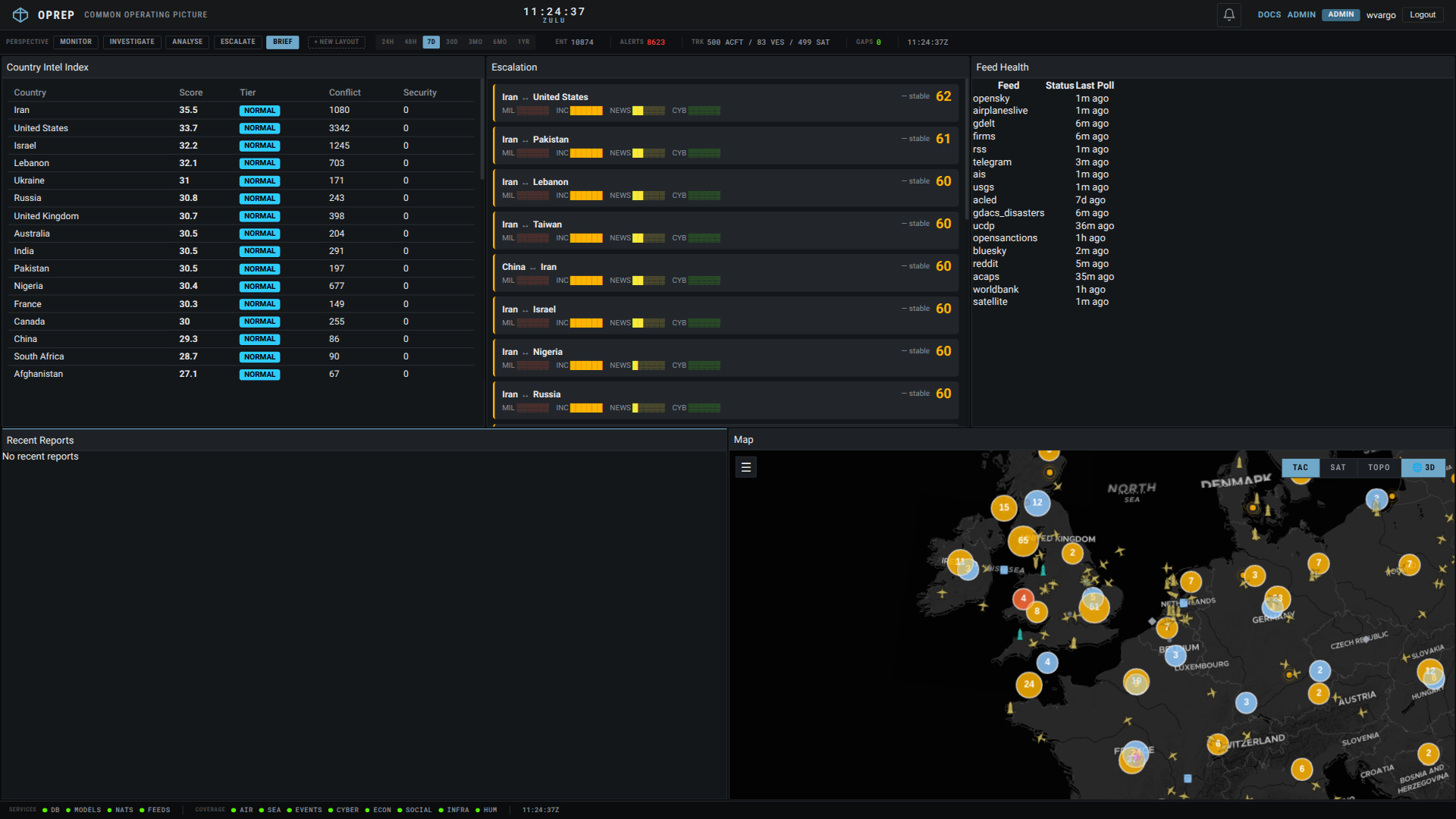
A unified operational picture, backed by an intelligence graph.

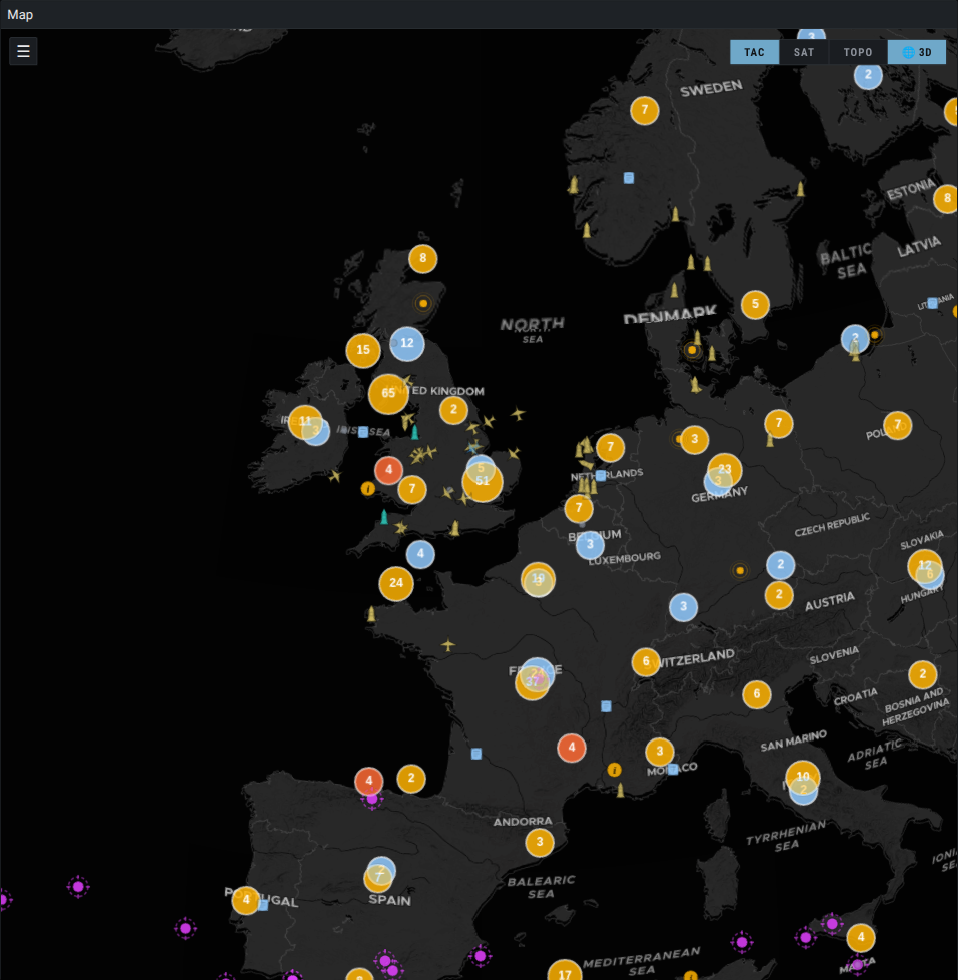
OPREP connects source data, entity relationships, analytic workflows, and reporting into one platform. Every assessment remains tied to evidence, provenance, confidence, and classification controls.

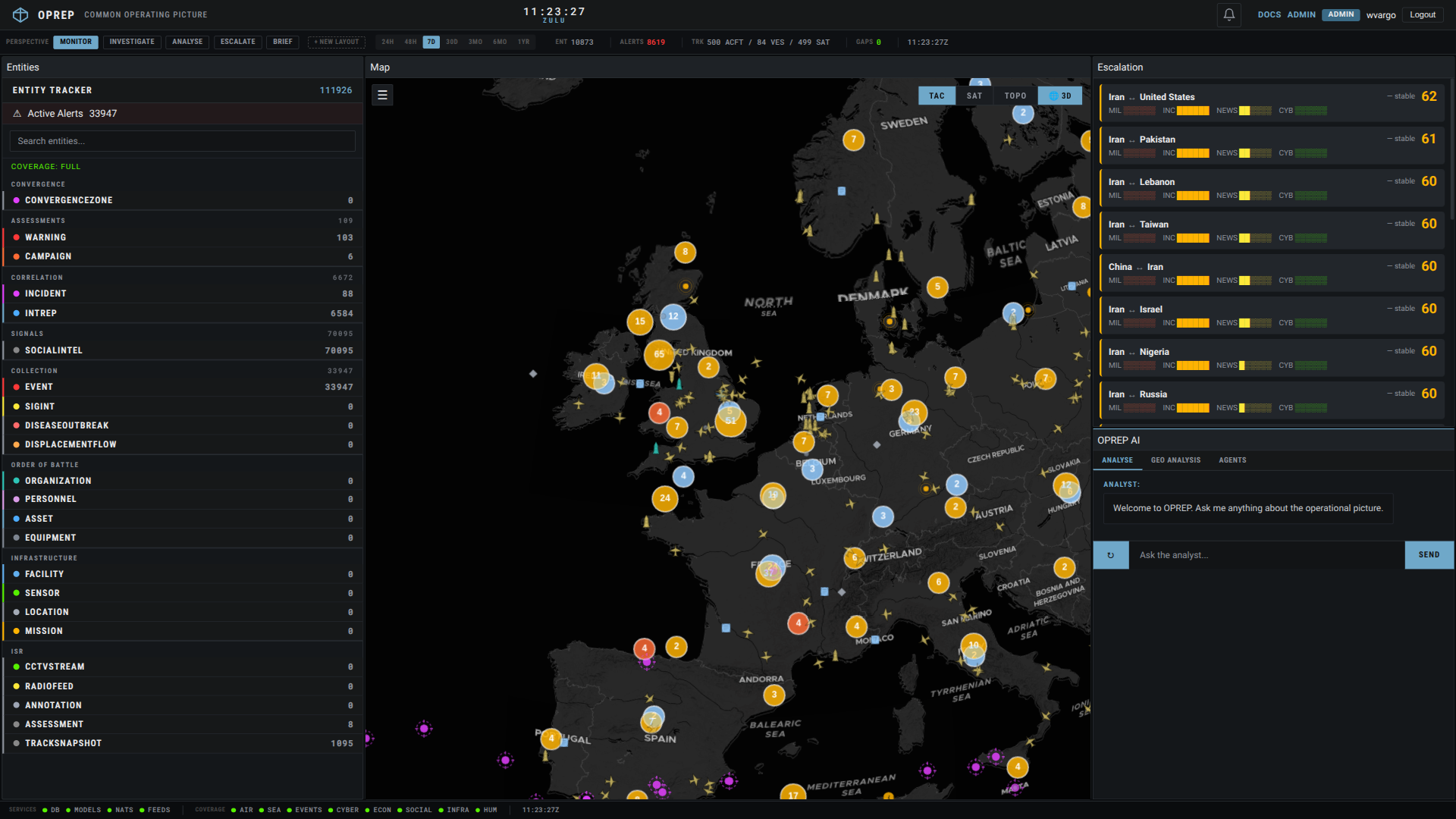
OPREP operational picture with source-weighted intelligence correlation
FIG. 01 · COMMON OPERATING PICTURE · ENTITY GRAPH · SOURCE-WEIGHTED CORRELATION
Source-weighted assessment

Every conclusion remains tied to the evidence behind it.

OPREP evaluates sources, credibility, recency, proximity, and correlation before turning information into an operational assessment.

01

Source

Mission feeds, partner reporting, sensors, tracks, cyber indicators, and open sources enter with provenance intact.

02

Reliability

Each source carries standing reliability and information credibility so confidence can be explained.

03

Correlation

Entities are resolved, matched by time and location, and linked to incidents, warnings, and campaigns.

04

Assessment

Analysts receive evidence-backed outputs with confidence, classification, and audit context preserved.

Operating model

From source data to operational decision support.

A continuous workflow ingests mission sources, resolves entities, correlates events, and produces intelligence products for analyst review.

Stage 01

Ingest

  • Mission data and operational reporting
  • Classified, partner, and open sources
  • Sensor, track, imagery, and cyber feeds
  • Source reliability and credibility metadata
Stage 02

Resolve

  • Persistent entity graph
  • Cross-source entity resolution
  • Semantic and geospatial matching
  • Classification-filtered graph traversal
Stage 03

Correlate

  • Incidents, warnings, and campaigns
  • Indicators and warnings evaluation
  • Track-event correlation
  • Graph anomaly detection
Stage 04

Produce

  • Common operating picture
  • Formal intelligence products
  • Analyst approval workflows
  • Persistent audit trail
Platform

The platform layer for sovereign intelligence operations.

OPREP combines source integration, graph analytics, controlled agent workflows, and formal reporting on infrastructure you control.

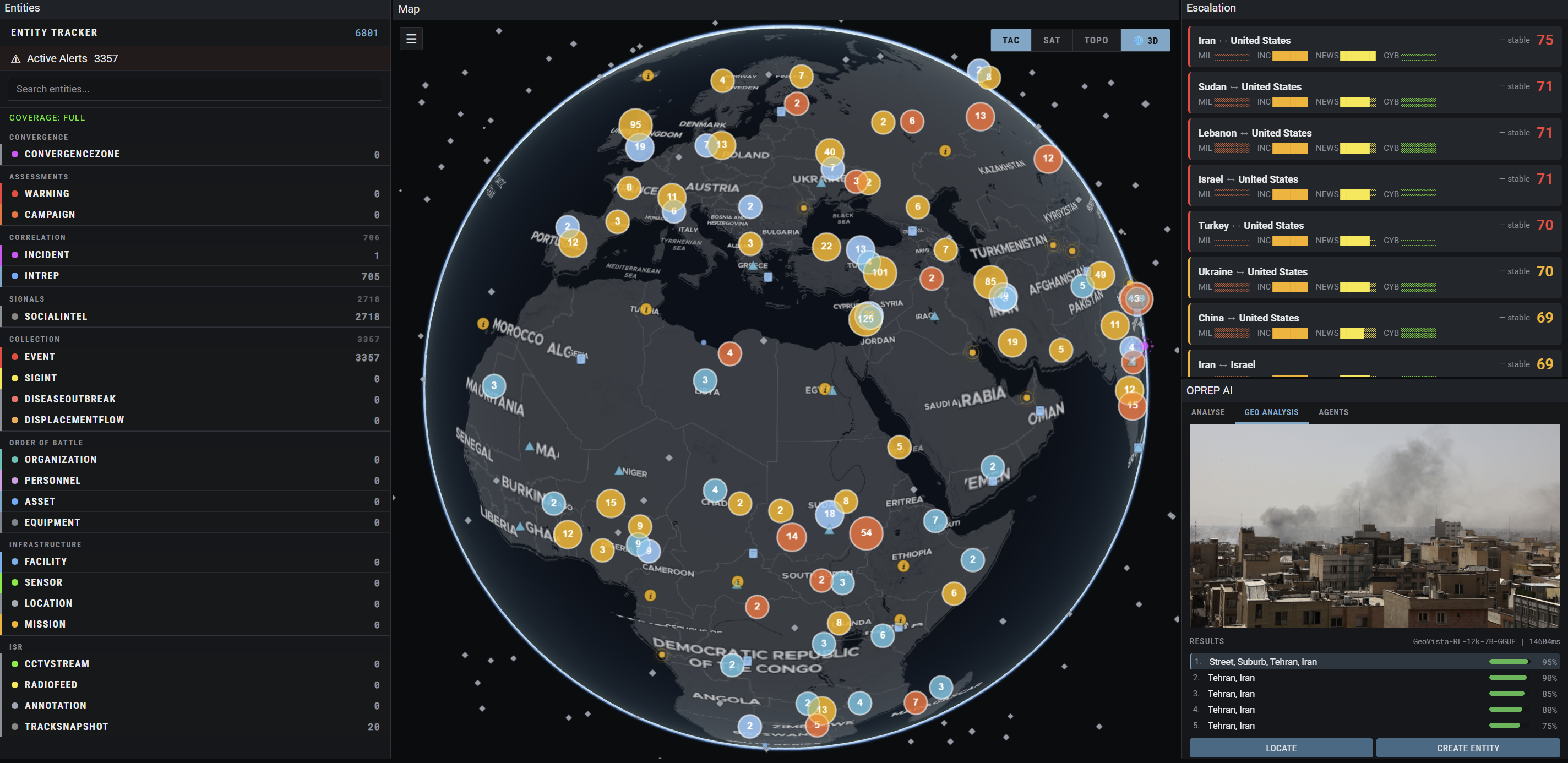
All-source fusion on the operational picture
Capability 01

Mission data integration

Integrate classified feeds, operational reporting, partner intelligence, sensors, tracks, imagery, cyber indicators, and open sources. OPREP preserves provenance and source context while bringing mission data into one governed picture.

Mission sources · Provenance · Controlled access
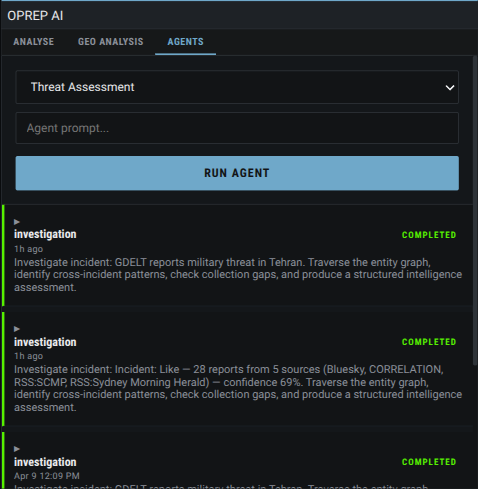
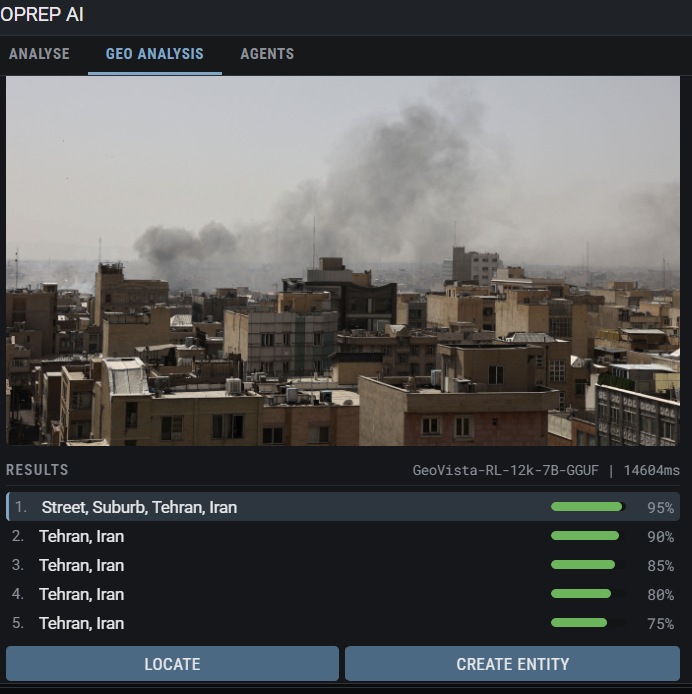
AI agent workflow panel
Capability 02

Controlled agent workflows

Agent workflows plan, execute, validate, and audit analytical tasks against the intelligence graph. Threat assessment, investigation, correlation, and reporting remain analyst-directed, with approval gates and persisted audit records.

Planner · Validator · Human approval
Correlation engine view
Capability 03

Source-weighted correlation

Correlate events using source reliability, information credibility, recency, spatial proximity, semantic similarity, and evidence diversity. OPREP resolves duplicate entities, creates incidents, evaluates warnings, and links evidence to every assessment.

Incidents · Warnings · Campaigns
Structured intelligence reports
Capability 04

Formal intelligence products

Generate IIR, INTSUM, INTREP, SITREP, SPOTREP, SALUTE, STANAG 2022, and investigation reports from governed source context. Products carry source evaluation, confidence language, classification markings, and trigger provenance.

Structured · Source-evaluated · Persisted
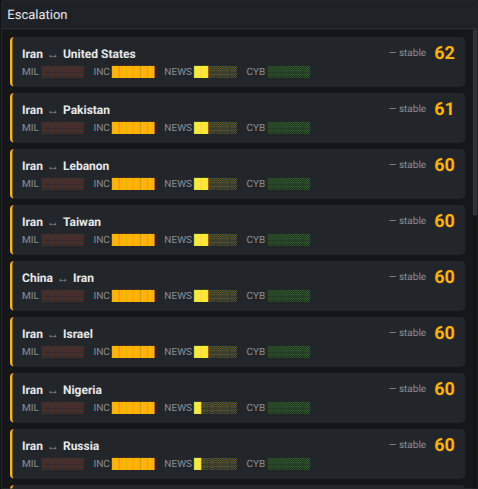
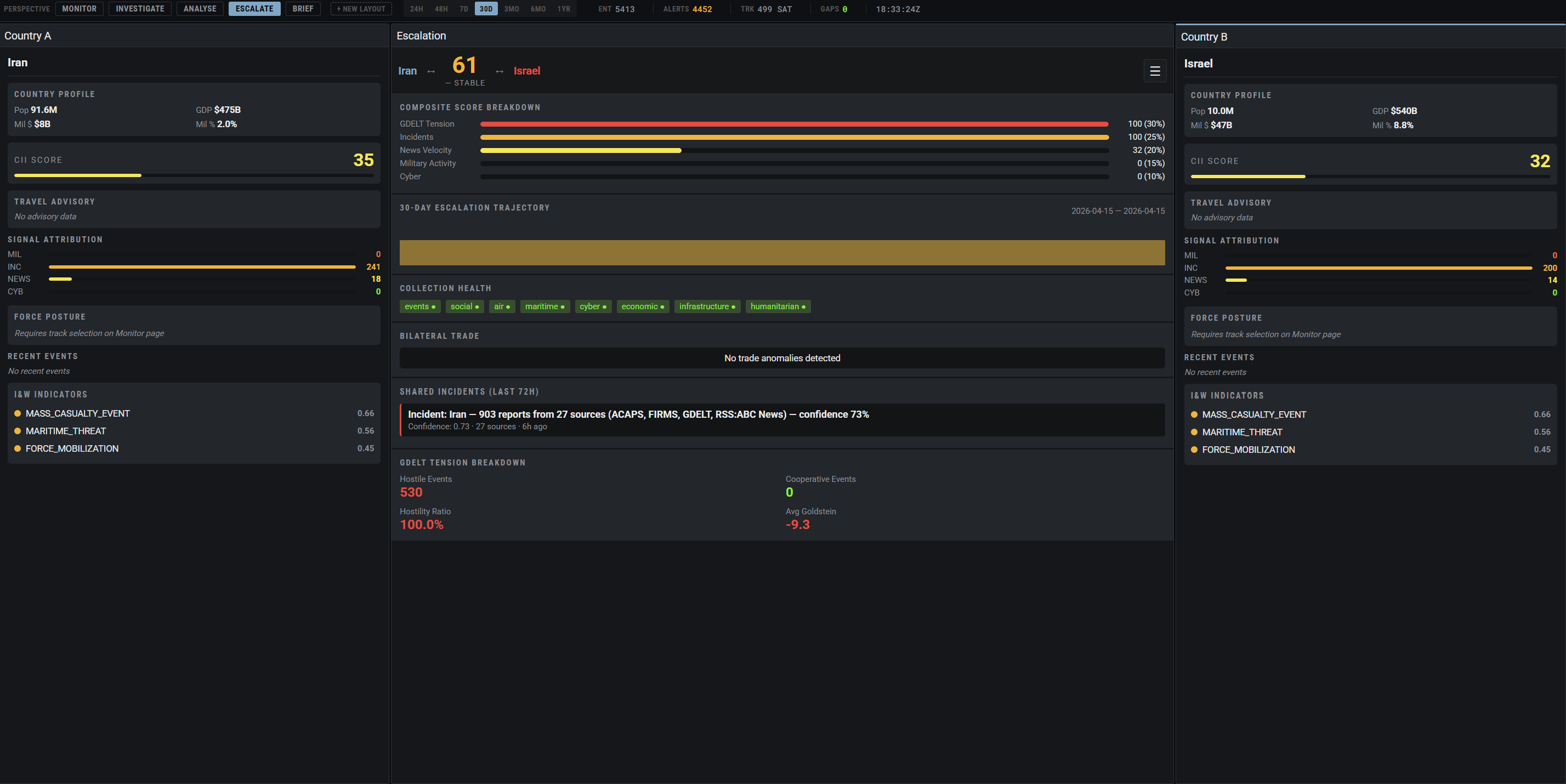
Indicators and warnings escalation view
Capability 05

Indicators & warnings

Evaluate configurable warning patterns across entities, tracks, source reliability, spatial proximity, and temporal recency. OPREP surfaces warnings only when required evidence conditions are met.

Evidence conditions · Thresholds · Analyst review
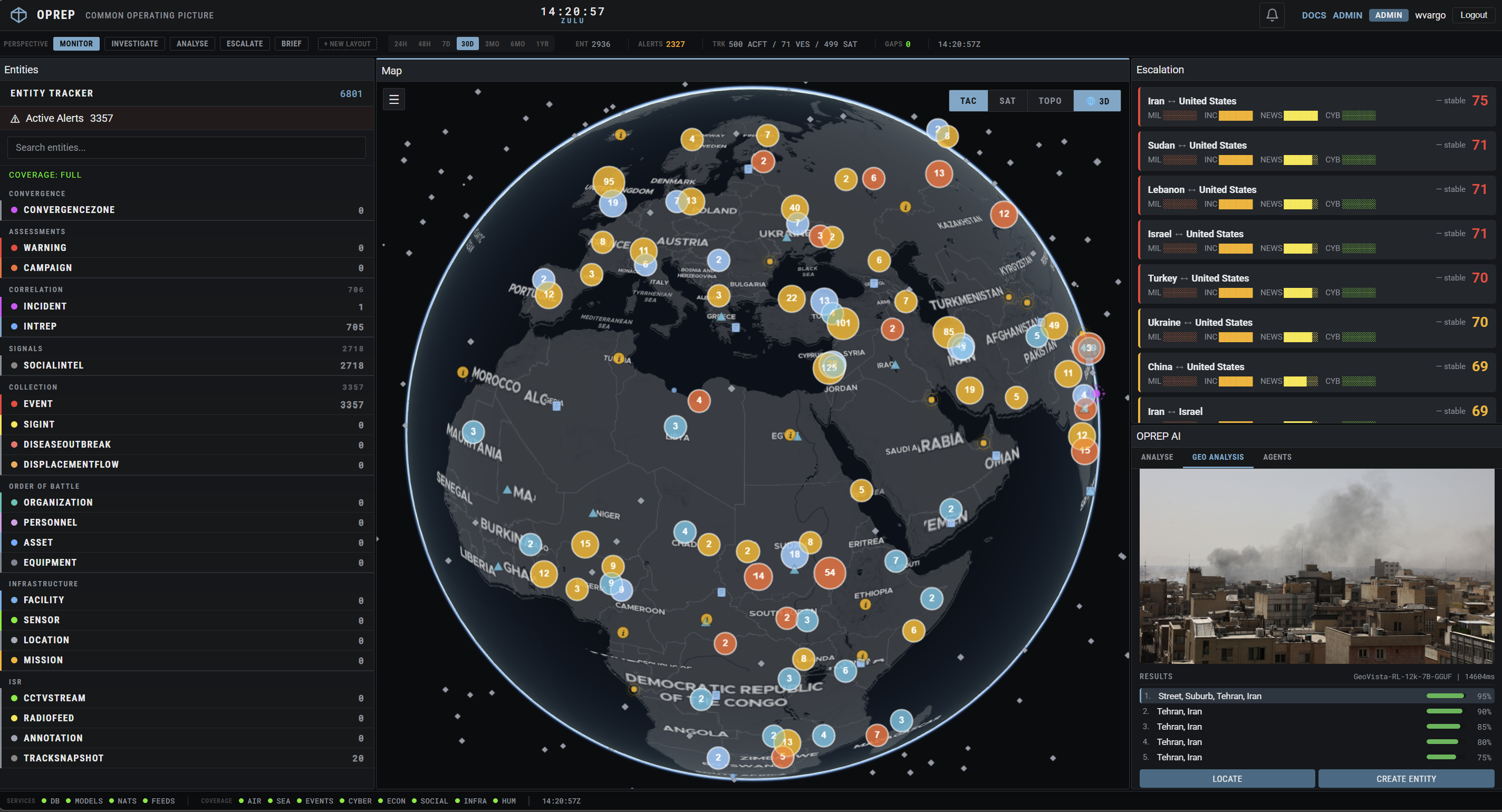
OPREP entity panel and dashboard view
Capability 06

Operational entity graph

Persist intelligence objects, relationships, annotations, assessments, and source evidence in a searchable mission graph. Analysts can traverse links, explain connections, detect structural anomalies, and inspect how entities evolve over time.

Semantic search · Link analysis · Audit history
Intelligence products

Outputs built for operational decision-making, not generic summaries.

OPREP turns governed source context into formal reporting formats with source evaluation, confidence language, and classification context preserved.

IIR Intelligence Information Report
INTSUM Intelligence Summary
INTREP Intelligence Report
SITREP Situation Report
SPOTREP Time-sensitive observation
SALUTE Tactical contact report
STANAG 2022 Formal evaluated report
INVESTIGATION Graph and network intelligence
Sovereign by design

Controlled data. Controlled infrastructure. Controlled operations.

OPREP is designed for deployment on customer-controlled infrastructure, with local model execution, classification-aware access, and no dependency on external AI services for core capability.

Pillar 01

Local AI inference

Run core AI workloads on your own GPUs. External model providers can remain disabled where policy, classification, or mission constraints require local execution.

Pillar 02

Air-gapped capable

Outbound connectivity can be disabled for air-gapped or disconnected environments. OPREP continues operating against local data, local models, and approved internal sources.

Pillar 03

On-premise deployment

Deploy with Docker, Kubernetes, or bare metal patterns on customer-controlled hardware. Keep the operational system inside the infrastructure boundary.

Pillar 04

Classification-aware

Classification-based filtering from UNCLASSIFIED through TOP SECRET, role-based permissions, clearance-aware access, and audit logging for graph and security events.

Deployment On-premise
Connectivity Disconnected / air-gapped
Compute Customer-controlled GPU
Core AI No external dependency

OPREP is not a hosted SaaS product. It is deployed inside the customer's operational boundary.

Request a briefing

Evaluate OPREP for your operating environment.

Discuss mission sources, classification policy, deployment constraints, and the intelligence products your organisation needs to generate.